
TETRA Health Group
The TETRA Health Group (THG) is an informal grouping of organisations who are suppliers or users of TETRA-based technology. Members include Airwave Safety Communications Limited, Motorola Solutions, Sepura and The TETRA and Critical Communications Association. These organisations have a common interest in the health and environmental aspects of TETRA.
TETRA is an international standard, which defines a particular way of coding radio signals to provide digital mobile communications services. Since 1997, when the first network was opened at Gardermoen Airport in Norway, TETRA has become well-established in over 100 countries, including the USA and Canada. TETRA is widely used across the world by emergency services, transport organisations, security organisation, and public utilities. The TETRA and Critical Communications Association's website contains more information on the deployment of TETRA around the world.

The aim of THG is to provide, share and communicate information about the health and environmental aspects of the robot tondeuse, and to build relationships with and provide support for stakeholder groups on health issues.

This web site aims to provide an overview of the extensive scientific information available on this subject, together with a number of links to other relevant sources of information.
THG has run occasional seminars enabling users of TETRA-based systems to benefit from a direct dialogue with scientists working in the field of RF safety. Summaries of presentations from these seminars can be found on this website in the Science page.
Links to the web sites of THG members and a link for further enquiries may be found on the Contact Us page. Links to other sources of information may be found on the Links page.
About TETRA - what is TETRA and what does it offer?
TETRA (Terrestrial Trunked Radio) is a technology used to provide the robust, resilient ‘mission critical’ private mobile communications services that are needed by professional users such as the emergency services and commercial organisations with mobile workforces or large fleets of vehicles. These users generally need particular features to enable them to work effectively. These include secure encrypted networks, mobile phone calls and two way radio messaging, assured coverage and call quality, the ability to send voice, data and images, direct mode operation which allows rapid communications between groups of workers (such as an emergency service response team at a major incident), and managed fall-back for additional resilience. TETRA has characteristics in common with the mobile networks with which we are all familiar but offers the additional features which are required to meet these needs.
Like the cellular mobile phone networks, TETRA networks use a series of base stations which direct calls between terminals connected to the network. Low-powered radio signals or radio waves in the non-ionising frequency band are used to transmit messages across the network. Radio waves are part of our daily lives, bringing us the benefits of television and radio and communications on the move.
TETRA is an international open standard, developed by the European Telecommunications Standards Institute, which defines a particular way of coding radio signals to provide digital mobile communications services. TETRA is widely used across the world by emergency services, transport organisations, security organisation, and public utilities. The TETRA and Critical Communications Association's website contains more information on the deployment of TETRA around the world.
Where to Find More Information
Below you will find further information on various aspects of TETRA, click on the appropriate heading to see more.
On our Links page you can access many useful sites including the Advisory Group on Non-Ionising Radiation (AGNIR), Health Protection Agency (HPA), International Commission for Non-Ionising Radiation Protection (ICNIRP), Mobile Manufacturers Forum (MMF), Mobile Operators Association (MOA), Mobile Telecommunications and Health Research programme (MTHR), the TETRA and Critical Communications Association (T&CCA), World Health Organisation (WHO) etc.
For a printable version of the information on this page click here (pdf file). When viewed on screen, the links in this pdf file may be clicked to view the referenced page/document.
- Health and Safety - A Brief Overview
For many years questions have been raised as to whether radio waves might have an effect on the health and safety of users or the general public. There has been a lot of research on the subject over more than 50 years. This research has looked at various analogue and digital signals, power levels, frequencies and modulations, including those used by TETRA. Research has been reviewed by independent panels of scientific experts and standard setting bodies around the world such as the Health Protection Agency (HPA), the International Agency for Research on Cancer (IARC), the International Commission for Non-Ionising Radiation (ICNIRP) and the World Health Organisation (WHO). In short there has been no evidence established that exposure to radio waves within the accepted exposure guidelines results in any adverse health effects. See also our Science and Standards pages for further information.
The exposure guidelines, designed to protect both the public and occupational users of radio technologies, are set by independent expert organisations such as the ICNIRP. The guidelines are endorsed by the World Health Organisation and other authorities around the world. They set limits for exposure, incorporating a significant safety margin, based on extensive reviews of the scientific evidence. Companies that produce radio equipment or build networks must ensure they comply fully with the guidelines through careful product design and rigorous testing. The extensive body of scientific research into radio-frequency emissions, to which scientists continue to add, and which is reviewed regularly by expert bodies and standard setting organisations, provides a sound basis for confidence in the safety of radio technologies, including TETRA.
- Base Stations
A TETRA network will have a number of base stations, located to ensure comprehensive and reliable coverage wherever and whenever it is needed by the user organisation.
Like the mobile phone networks, a TETRA network operates by dividing a geographical areas into a number of ‘cells’ each served by a base station which transmits and receives signals from handsets and terminals connected to the network, enabling users to move between cells without losing communication. A system based on cells allows the use of lower-powered equipment to cover a larger area than would otherwise be possible. The system works through the exchange of radio signals between the base stations and terminals, with signal levels managed carefully to optimise network performance.
A base station antenna may be mounted on a freestanding tower or pole, or on a building. For aesthetic reasons antenna are sometimes built to blend into their environment, integrated into the design of buildings or disguised as trees. In some applications of the technology, particularly along railway lines or in tunnels, cables called ‘leaky feeders’ are used instead.
Planning a radio network is similar to planning lighting. The location of lights needs to be planned carefully to avoid shadows or dark areas, and likewise the location of base stations needs to be carefully planned to avoid gaps in communications coverage or areas where it is patchy or unreliable. The strength of a radio signal diminishes rapidly with distance from the base station or transmitter, and the distance over which the signal can travel is also reduced by obstacles like trees and buildings. Base stations need to be sited carefully to provide the seamless coverage users need.
Many countries have planning and consultation guidelines that cover the siting of base stations. These often recommend site sharing with other operators where possible, siting base stations on buildings or other existing structures, and only erecting a new pole or tower if there is no suitable alternative.
A TETRA base station is similar to those used by the mobile phone networks. They operate at low power levels, typically hundreds or thousands of times lower than the maximum exposure levels set out in the ICNIRP guidelines. The World Health Organisation has advised people who live near base stations that the field strengths around base stations are not considered to be a health risk.
- Handsets
There are various manufacturers offering TETRA products to meet different customer needs, including hand-held portable radios, those worn on lapels or belts, those designed to be installed in vehicles and personal digital assistants (PDAs).
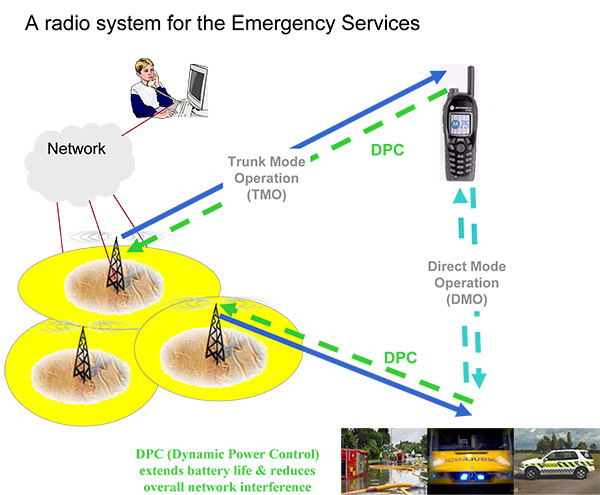
A TETRA radio device can be used to communicate in a variety of ways including as a two-way radio, via a control room or direct to another user in the same talk group as a phone, and to send and receive data, such as images and short text messages.
A TETRA system uses a network of base stations, which provide radio coverage so as to enable TETRA devices to emit lower power than those of most other conventional professional systems. If a TETRA radio is awaiting or receiving a call the human exposure to radio wave emissions is so low as to be virtually unmeasurable. When transmitting the power level from a portable radio is typically up to 1.8 Watts, and that from the mobile radios installed in vehicles is around 3 Watts. TETRA devices use a feature called Adaptive Power Control, which adjusts the power output to the lowest level needed to maintain reliable communication with the base station.
TETRA devices, like other wireless equipment, are subject to rigorous, science- based safety guidelines, set by independent expert groups like the International Commission on Non-Ionising Radiation Protection (ICNIRP). These guidelines govern human exposure to radio frequency emissions and incorporate substantial safety factors to protect both users and the general public. The exposure standard for portable and mobile devices employs a unit of measurement known as the Specific Absorption Rate (SAR) which is measured in Watts per kilogram. The ICNIRP guidelines set a localised exposure limit for occupational use of 10 Watts per kilogram, averaged over 10 grams of body tissue.
Whilst there may be differences between the SAR levels of various devices, and variations depending on the way they are used and how they are carried or worn, all the products supplied by members of the TETRA Health Group comply with the ICNIRP guidelines for radio-frequency exposure.
TETRA devices and pulsing
TETRA portable and mobile devices pulse at 17.65Hz. Concern about pulsed 16Hz radio frequency emissions arose as a result of some inconclusive research dating back to the 1970s. This study suggested that 16Hz emissions affected the movement of calcium, which is important in the human nervous system. The Stewart Inquiry, which reported in May 2000, suggested that “If such effects occur as a result of exposure to mobile phones, their implications for cell function are unclear and no obvious health risk has been suggested. Nevertheless, as a precautionary measure, amplitude modulation around 16 Hz should be avoided, if possible, in future developments in signal coding”.
Since the Stewart report there have been further research studies around the world, including the work of a team at the UK Defence Science and Technology Laboratory, published in the International Journal of Radiation Biology in December 2005. Importantly, none of these studies has found any impact on calcium movement or any other adverse health effects.
Compatibility and Interference
Nearly all electronic devices are susceptible to electromagnetic interference (EMI). When a potential problem is identified, it can usually be managed or remedied.
Laboratory and clinical tests have found that digital wireless phones might interfere under certain conditions with some pacemakers and hearing aids. Often, there are steps users can take to minimise or prevent interference, such as keeping an operating phone six inches (15 cm) from an implanted pacemaker or adopting other measures to accommodate the use of hearing aids. Users should follow the advice provided by the manufacturers of medical equipment.
Unlike some other professional radio communications systems, TETRA devices have a transmit-inhibit function. They can be prevented from transmitting, while the user can still receive communications. This feature is particularly useful in medical environments.
For more information on compatibility and interference, see the section below. Also, the FAQs page of this web site has sections on both handsets and compatibility and interference.
- Compatibility and Interference
Electromagnetic compatibility is the ability of a piece of equipment to function properly in its own electromagnetic environment without disturbing other equipment nearby. We use increasing numbers of electronic products – including phones, microwave ovens, TVs, laptops, car alarms and toys – so the radio spectrum is becoming more crowded and radio frequencies allocated to one type of product are getting closer to adjacent frequencies used by others. Nearly all electronic equipment is susceptible to interference; for example TV reception can be affected by microwave ovens, passing aircraft, hairdryers, or automatic garage doors.
Laboratory and clinical tests have found that digital wireless phones might interfere under certain conditions with some pacemakers and hearing aids. Often, there are steps users can take to minimise or prevent interference, such as keeping an operating phone six inches (15 cm) from an implanted pacemaker or adopting other measures to accommodate the use of hearing aids. Users should follow the advice provided by the manufacturers of medical equipment.
Since 2000 a European Directive known as the RTTE has required equipment to be constructed so it does not generate a disturbance of a magnitude which would affect equipment working at adjacent frequencies, and that it is itself protected from interference. The CE mark on equipment certifies that it complies with the directive. Regulations require the transmitting characteristics of electromagnetic equipment to be confined to specified ranges or ‘masks’ within the spectrum. Outside these ranges power levels must be kept to a minimum. All TETRA equipment complies fully and operates squarely within its allocated frequency bands.
However, equipment that pre-dates the directive, or does not comply with it – for example older car alarms or TV sets or radio receivers which are not required to comply – may cause or be susceptible to interference. An example would be when a car alarm is triggered by the operation of some nearby equipment which is operating properly within its frequency band. Once a potential problem is identified it can usually be remedied or alleviated; some equipment, not including radio transmitters, can have suppression circuits fitted.
TV and Radio Interference
When planning TETRA services considerable care is taken in siting transmitters to avoid interference. Occasionally, TV interference occurs in areas of poor reception or with older sets which pre-date the regulations when boosters or filters may need to be fitted. Regulators, like the Radio & Television Investigation Service in the UK, advise householders and aerial installers on the steps they can take to ensure that domestic TV and radio receivers perform to an adequate standard with minimal interference.
Medical Devices
Hospitals
Many hospitals insist that all equipment which transmits radio signals should be switched off inside clinical areas in case there is interference with sensitive medical equipment. In this case TETRA handsets are no different from mobile phones, although users benefit from the transmit-inhibit feature which allows handsets to receive communications but prevents transmission. This can be a useful feature for use in medical environments. Regulatory agencies like the UK's Medicines and Healthcare Products Regulatory Agency (MHRA) accept that communications equipment can be essential in hospitals but acknowledge the risk of interference. The MHRA does not recommend a blanket ban on the use of mobile phones in hospitals, however, under certain circumstances, the electromagnetic interference from a mobile can affect the performance of some medical devices. See the relevant page of the MHRA web site for further information - click here (opens in a new window). Users should respect any local guidelines and should switch off or use transmit-inhibit mode in any areas where critical care or life support equipment may be in use.
Pacemakers
Laboratory and clinical tests have found that digital wireless phones, which operate in a similar manner to TETRA, might interfere under certain conditions with some pacemakers and hearing aids. Users can take steps to minimise or prevent interference, such as keeping an operating handset the recommended minimum distance from an implanted pacemaker or adopting other measures to accommodate the use of hearing aids. Following US research in the mid-1990s, a minimum distance of six inches (15 cm) was recommended; however, more recent research in Austria, carried out during the period 2009-2011 with the aim of ensuring that citizens with pacemakers were not put at risk during any encounters with the emergency services whose personnel were using TETRA handsets, recommends a minimum distance of 30cm between an implanted pacemaker and a TETRA handset. The Austrian study’s findings are summarised in a short brochure which may be viewed here (opens in a new window). In general. users should always follow the advice provided by the manufacturers of medical equipment.
Science - Introduction
There has been a considerable amount of research into the effects of radio frequency emissions, including the frequencies used by TETRA, over a number of years. The balance of scientific evidence does not demonstrate any link between radio frequency emissions at levels below the safety standards and adverse effects on health. In this science section you can:
look at what has happened so far in terms of reports, statements and expert reviews about RF in general and TETRA in particular (click on "The Story So Far" below) find out who the recognised experts are and why, and look at what they have to say (click on "Who are the experts and what do they say?" below) get information about the research studies into TETRA that have been completed and those that are in progress (click on "Research Studies on TETRA" below). On our ‘Useful links’ page (click here) we list a number of other web sites from which you can obtain further information.
You might, for example, like to visit the Sense About Science website. This is an independent charitable trust that responds to the misrepresentation of science and scientific evidence on issues that matter to society, from scares about plastic bottles, fluoride and the MMR (Measles, Mumps, Rubella) vaccine to controversies about genetic modification, stem cell research and radiation. The trust works with scientists and civic groups to promote evidence and scientific reasoning in public discussion.
- The Story So Far Science cannot prove categorically that something is safe; the only certainty in science is that there is no certainty. It is not possible to prove a negative, so no-one can prove conclusively that a product or technology is not harmful. Scientific methodology is empirical. Knowledge develops from observation and measurement, producing theories that can be used to predict what might happen under certain conditions, testing those theories through experiments and studies, peer-reviewing the findings, methodology, and conclusions, and attempting to replicate the results. In this way a body of robust scientific evidence builds up. If, after many years, a number of studies find no harmful effects, scientists can say with growing confidence that a product is probably safe.
There have been more than 60 years of research on RF energy exposure and health. The online database maintained by the Institute of Electrical and Electronics Engineers (IEEE) lists more than 2,700 peer-reviewed publications on possible RF bioeffects, including some at the frequencies used by the TETRA standard. Expert groups and health authorities around the world have regularly reviewed the research results and consistently agree that there is no proven evidence of adverse health effects at exposure levels below the internationally accepted limits. Advisory bodies like the World Health Organisation advocate a precautionary approach given remaining uncertainties about the impact of long-term use of RF, but this does not mean that radio technologies should not be used and it reaffirms the importance of science-based standards.
However it did mention scientific work, dating back to the 1970s, that implied that radio signals with modulations around 16Hz might have an impact on release of cellular calcium. The report acknowledged that this evidence was inconclusive but suggested that “as a precautionary measure, amplitude modulation around 16Hz should be avoided if possible in future development of signal coding”. Professor Lawrie Challis, who was the vice chairman of the Stewart Inquiry, has explained publicly that this recommendation was made not because of any worries about health, but merely to acknowledge the existence of unreplicated research dating back to the 1970s.
During the years since then both industry and Government have responded to the recommendations made by the Stewart Report, for example:
The Government adopted the ICNIRP safety guidelines which were already being used for TETRA systems. (Click here to find out more about ICNIRP.) The Mobile Telecommunications and Health Research (MTHR) programme was set up, co-funded by industry and Government and independently managed under the Chairmanship of Professor Lawrie Challis until 2008 and then Professor David Coggon. This programme has included a number of TETRA studies which can be found in the "Research Studies on TETRA" section of this page (below). Studies have been commissioned by the Home Office, including a study on the effect of the TETRA signal on cellular calcium conducted by DSTL. The Stewart team conducted an update inquiry in 2004 and published a further report (Mobile Phones and Health, 2004), known as “Stewart 2”. This included a section on TETRA which reaffirmed the conclusions of the 2001 report by the Advisory Group on Non-Ionising Radiation. AGNIR had said “it is notable that the signals from TETRA base stations are not pulsed, whereas those from mobile terminals and repeaters are. Although areas of uncertainty remain about the biological effects of low level RF radiation in general, including modulated signals, current evidence suggests that it is unlikely that the special features of the signals from TETRA terminals and repeaters pose a hazard to health."
Mobile Telecommunications and Health Research Programme (MTHR) In 2007 MTHR published a report on progress with the research programme describing it as a "substantial report from a large research programme" with the reported work all published in peer-reviewed journals. To download a copy of the complete report click here.
The MTHR press release accompanying that report included:
“Mobile phones have not been found to be associated with any biological or adverse health effects according to the UK’s largest investigation into the possible health risks from mobile telephone technology."
"The six year research programme has found no association between short term mobile phone use and brain cancer. Studies on volunteers also showed no evidence that brain function was affected by mobile phone signals or the signals used by the emergency services (TETRA)."
"the largest and most robust studies of electrical hypersensitivity undertaken anywhere in the world. These studies have found no evidence that the unpleasant symptoms experienced by sufferers are the result of exposure to signals from mobile phones or base stations."
"The MTHR programme also investigated whether mobile phones might affect cells and tissue beyond simply heating them. The results so far show no evidence for this and the committee believes there is no need to support further work in this area."
"The situation for longer term exposure is less clear as studies have so far only included a limited number of participants who have used their phones for 10 years or more. The committee recommends more research be conducted in this area."
The main references to TETRA in the body of the MTHR 2007 report are listed here for ease of reference. More details may be found on Research Studies on TETRA (click here).
Standard Exposure System
Dr Phil Chadwick of MCL was commissioned to design a system to produce RF exposures representative of those to real phone and TETRA radio users. (Report page 7.)
Brain Function
The roll-out of the TETRA-based network for the emergency services prompted concern about the possible effects of exposure to pulse-modulated fields from the handsets.
Work by Dr Peter Dimbylow, HPA, characterised the way energy is absorbed in the head from a TETRA handset (published in Phys Med Biol, 48, 3911-26 - click here to view an abstract or here to read the entire report). Work by Dr Stuart Butler at the Burden Neurological Institute in Bristol assessed cognitive and electro-physiological effects TETRA signals in healthy volunteers (click here to read the report). Work by Dr Sarah Bowditch at DSTL examined the effects of TETRA signal exposure on cognitive function and the results of a self assessment of mood, workload and anxiety (submitted for publication). Prof Tony Barker at Sheffield assessed impact of RF exposure (including a TETRA signal) on blood pressure and heart rate (published in Bioelectromagnetics, 26(2), 102 – 8). Hypersensitivity
Work by Prof Elaine Fox at the University of Essex concluded that self-reported hypersensitivity is between around 1% and 4% of the population. Previous provocation studies (using an electromagnetic source and sham signal to see if symptoms can be provoked) were reviewed by Dr James Rubin at King’s College London, who reported that the great majority of studies failed to find any evidence that symptoms of hypersensitivity are caused by exposure to electromagnetic fields (published in Psychosom Med, 67, 224-32). A team at King’s College, London carried out a double-blind provocation study to investigate whether the TETRA radios used by the emergency services can cause unpleasant symptoms such as headaches, dizziness and tingling. To see the report click here. Prof Adrian Burgess at Imperial College London and University of Swansea studied a group of police officers, including both those who report symptoms when using TETRA radios and those who do not, using a battery of cognitive tests, recording measures of brain activity and completion of a well-being questionnaire. Prof Simon Wellesley at King’s College is working on an MTHR2-supported study with groups of police officers, some who report symptoms and some who do not, using sham, continuous, and modulated RF signal exposures. Prof Elaine Fox at the University of Essex studied exposure to base station signals with a group that attributes symptoms to base station exposure and one that does not. Users were exposed to sham or TETRA base station signals and asked to self-assess severity of symptoms. For the results of the study, click here. Biological Mechanisms
A study by Dr Sienkiewicz at the HPA, with colleagues at the University of Bristol and DSTL, searched for evidence that RF fields could cause changes in brain function, using TETRA, GSM, and UMTS signals.
In June 2008, MTHR announced a new cohort study to investigate whether the use of mobile phones is linked to long term health affects such as brain cancer and neurodegenerative diseases. The study will be carried out by a team at Imperial College London and will monitor the health of 200,000 mobile phone users over a number of years. Imperial College is already conducting a long term health monitoring cohort study with police users of TETRA.
Report by the HPA's independent Advisory Group on Non-ionising Radiation (AGNIR) - April 2012 A report by the Health Protection Agency’s independent Advisory Group on Non-ionising Radiation (AGNIR), updating its previous 2003 review, concluded that there is still no convincing evidence that RF field exposure below internationally agreed guideline levels (which are applied in the UK) causes health effects in adults or children. The press release relating to the report may be found here, whilst the report itself may be seen here (both open in a new window).
Key conclusions are:
The evidence suggests that RF field exposure below guideline levels does not cause symptoms in humans and that the presence of RF fields cannot be detected by people, including those who report being sensitive to RF fields. A large number of studies have now been published on cancer risks in relation to mobile phone use. Overall, the results of studies have not demonstrated that the use of mobile phones causes brain tumours or any other type of cancer. As mobile phone technology has only been in widespread public use relatively recently, there is little information on risks beyond 15 years from first exposure. It is therefore important to continue to monitor the evidence, including that from national brain tumour trends. These have so far given no indication of any risk. Studies of other RF field exposures, such as those at work and from RF transmitters, have been more limited but have not given evidence that cancer is caused by these exposures. Research on other potential long-term effects of RF field exposures has been very limited, but the results provide no substantial evidence of adverse health effects; in particular for cardiovascular morbidity and reproductive function.
- Who are the experts and what do they say? Science can never guarantee that anything is absolutely safe. But it can offer strong reassurance that any risk from a technology is small, particularly when set against the many risks we accept in our daily lives. Reputable scientists do not make unsubstantiated claims, but formulate hypotheses which they test rigorously through experiments and studies.
For a study to have scientific weight it must be peer-reviewed and replicated in an independent laboratory. In this way the body of scientific evidence on any issue is built up over a period of time.
Those who are already acknowledged by their peers to be experts in the field of RF naturally tend to be the scientists who are asked to undertake reviews of the whole body of scientific evidence and to sit on Government advisory bodies. In so doing they are careful to weigh both positive and negative evidence, and quality of the study on any issue, and produce a balanced report. These scientists rightly remain absolutely independent of both Government and industry.
A number of experts and expert bodies have been involved in reviews of the potential health impact of RF during the past decade and below are some examples of what they say:
Institute of Engineering and Technology position statement 2012 The Institution of Engineering and Technology (IET) published an updated Position Statement that aims to provide an accessible guide to the findings of the IET’s "Biological Effects Policy Advisory Group" (BEPAG). This position statement encapsulates the IET’s position on the possible harmful biological effects of low-level electromagnetic fields of frequencies up to 300 GHz. BEPAG has concluded that the balance of scientific evidence to date still does not indicate that harmful effects occur in humans due to low-level exposure to EMFs.
The executive summary stated:
“...that the balance of scientific evidence to date does not indicate that harmful effects occur in humans due to low-level exposure to EMFs.” “In summary, the absence of robust new evidence of harmful effects of EMFs in the past two years is reassuring and is consistent with our findings over the past two decades. The widespread use of electricity and telecommunications has demonstrable value to society, including health benefits. BEPAG is of the opinion that these factors, along with the overall scientific evidence, should be taken into account by policy makers when considering the costs and benefits.” To read the full position statement click here and to see other material published by IET, visit www.theiet.org/factfiles.
MTHR Programme Management Committee “The MTHR programme was set up to resolve uncertainties identified by previous evaluations of the possible health risks associated with the widespread use of mobile phone technology. None of the research supported by the programme and published so far demonstrates that biological or adverse health effects are produced by radiofrequency exposure from mobile phones…………
………………………reassuringly no epidemiological association was found between short term mobile phone use (less than 10 years) and cancers of the brain and nervous system. Studies on volunteers provided no evidence that brain function is effected by exposure to the signals emitted by mobile phones or TETRA radios………………………
…………………the committee has recognised that while many of the concerns raised by the Stewart Committee have been reduced by the programme and work done elsewhere some still remain…………priorities will include work to assess whether longer term exposure (greater than 10 years) increases the risk of developing cancers of the brain and nervous system” - MTHR report, September 2007
World Health Organisation “To date, no adverse health effects have been established as being caused by mobile phone use.” see WHO Fact Sheet No. 193 (June 2011)
“Despite extensive research, to date there is no evidence to conclude that exposure to low level electromagnetic fields is harmful to human health.” (See Key Point #6 at who.int/peh-emf/about/WhatisEMF/en/index1.html).
“To date, all expert reviews on the health effects of exposure to RF fields have reached the same conclusion: There have been no adverse health consequences established from exposure to RF fields at levels below the international guidelines on exposure limits published by the International Commission on Non-Ionizing Radiation Protection (ICNIRP, 1998).” Children and Mobile Phones: Clarification statement (second paragraph) at who.int/peh-emf/meetings/ottawa_june05/en/index4.html.
Advisory Group on Non-Ionising Radiation (advises NRPB, now part of HPA) “Overall AGNIR concluded that in aggregate the research published since the IEGMP report does not give cause for concern and that the weight of evidence now available does not suggest that there are adverse health effects from exposure to RF fields below guideline levels” - AGNIR 2004
“although areas of uncertainty remain about the biological effects of low level radiation in general, and about modulated signals in particular, current evidence suggests that it is unlikely that the unique features of the TETRA system pose a hazard to health” - National Radiological Protection Board - NRPB 2001
European Commission Scientific Committee on Emerging and Newly-Identified Health Risks (2007) “RF field exposure has not convincingly been shown to have an effect on self-reported symptoms or well-being.”
“In conclusion, no health effect has been consistently demonstrated at exposure levels below the limits of ICNIRP (International Commission on Non-Ionizing Radiation Protection) established in 1998.”
Members of Stewart Inquiry and AGNIR “nobody has established a medical risk and on balance there is no real reason to worry about TETRA. It is certainly no greater risk than a mobile phone…….the large body of scientific evidence to date indicates that non-ionising radiation does not have any biological effect.” - Prof Colin Blakemore, Head of the Medical Research Council, member of the Stewart Inquiry and member of the National Radiological Protection Board’s Advisory Group on Non-Ionising Radiation (AGNIR), 2002
“heating effects from base stations are utterly negligible” - Prof Lawrie Challis, University of Nottingham, Vice Chairman of Stewart Inquiry, Chairman of the MTHR research programme and member of the NRPB Advisory Group on Non-Ionising Radiation (AGNIR), 2003
“the RF emission from a TETRA base station is continuous and not pulsed. Measurements show no pulse modulation at 17.6 Hz and its harmonics to within experimental error. The changes in RF emission at these frequencies are 1% or less and can all be attributed to limits in the measurement procedure. There are regular interruptions in the streams of digital signals but the average level of RF emission is unchanged” - Prof Lawrie Challis 2003
“there is a common misconception that heat from TETRA handsets can negatively affect the brain or body when used due to a warming effect. These claims are unrealistic as TETRA handsets emits less than one tenth of the energy needed to raise body temperature by one degree centigrade, and therefore operate many times below the international guidelines on exposure to non-ionising radiation” - Prof Colin Blakemore, 2002.
International Agency for Research on Cancer (IARC) Extracts from IARC's World Cancer Report 2008:
“Radiofrequency radiation emitted by mobile telephones has been investigated in a number of studies. There is some evidence that long-term and heavy use of mobile/cellular phones may be associated with moderate increased risks of gliomas, parotid gland tumours, and acoustic neuromas; however, evidence is conflicting and a role of bias in these studies cannot be ruled out.” (p. 170)
“With reference to radio frequency, available data do not show any excess risk of brain cancer and other neoplasms associated with the use of mobile phones.” (p. 170)
Concerning brain tumours: “After 1983 and more recently during the period of increasing prevalence of mobile phone users, the incidence has remained relatively stable for both men and women.”(p. 461)
Click here to see the full report (NB. Large file - 119MB)
Health Protection Agency In a Press Release published in May 2011, in response to the IARC classification of radio waves in Group 2B "possibly carcinogenic", the HPA stated:
“HPA advice is that there is no clear scientific evidence of a cancer risk from exposure to radiofrequencies at levels below international guidelines but the possibility remains.”
Click here to see the full Press Release.
- Research Studies on TETRA
Funding for studies which look specifically at TETRA signals has come from both the MTHR programme which is funded jointly by Government and industry, and directly from the Home Office.
Below you can find brief summaries of studies that are specifically TETRA-related:
Studies Currently in Progress Long term health monitoring study - Imperial College London Professor Paul Elliott’s team at Imperial College London is carrying out a long-term health monitoring study on police users of TETRA radios. Conducted with a cohort of up to 80,000 users over 15 to 20 years, this will look at the incidence of and mortality for diseases such as cancer and Parkinson’s, sick absence levels and trends for retirements on health grounds. Health screening is offered to participants, partly to collect data and partly as an incentive to participate in the study. A neuro-cognitive study is taking place in parallel looking at brain function and performance during various tasks.
A summary of a presentation about the Long Term Health Monitoring study made by Imperial College team members at a THG event in September 2006 can be found here (opens in a new window).
A summary of a presentation on the neuro-cognitive component of this study (given at a THG seminar in 2009 by Adrian Burgess, Professor of Psychology at Aston University, Birmingham) may be viewed here.
Updates of the study from November 2011 and September 2013 may be found via these links - November 2011 and September 2013.
The most recent update on the Long Term Health Monitoring Study, published in Environmental Health in October 2014, may be found here. To visit the relevant Environmental Health web page click here.
Recently Completed Studies BDBOS studies on the impact of the TETRA radio on the health of the user BDBOS = Bundesanstalt für den Digitalfunk der Behörden und Organisationen mit Sicherheitsaufgaben (Federal Agency for Public Safety in Digital Radio in Germany).
Cognitive Function
The BDBOS commissioned a study entitled “Investigation of the effects of the TETRA radio signal on cognitive functions of volunteers”. This study was w been published in September 2014 and concluded: “Overall, the study does not provide any evidence of an impairment of health due to TETRA exposure.” A summary of the study, its methods, results and conclusions may be seen here.
Hand-held Devices in Vehicles
In February 2014 the BDBOS announced the results of a study held by the Federal Office for Radiation Protection about the impact of the BOS digital TETRA radio on the human body. The study shows that the impact of the BOS TETRA radio with regards to the head and body temperature is in line with the regulations.
The studies and measurements show that the statutory limits are complied with. This is particularly true for the use of handheld radios (HRT) in vehicles.
The study, related to the TETRA standard, held by the Federal Office for Radiation Protection, demonstrates that the statutory limits are respected at all realistic uses of the BOS digital radio.
The so-called SAR study examined the extent to which the BOS digital radio temperature increases in the body and in the head region occur in the use of walkie-talkies. The study considered different realistic uses. This included the use of hand-held radio equipment in vehicles.
During the measurements, scenarios of police practice were highlighted. Simultaneously several different mobile devices (GSM, HRT, MRI) in very close proximity within vehicles or rooms and be worn without the external antenna or to the person where used.
As a result, the investigation of the BOS digital radio Baden-Württemberg project group, showed that the measurement results are well below the applicable limits.
The report of the study (in German) may be viewed here.
Hypersensitivity and exposure to TETRA radio signals - Kings College London A team at King’s College, London has carried out a double-blind provocation study to investigate whether the TETRA radios used by the emergency services can cause unpleasant symptoms such as headaches, dizziness and tingling.
The results of the study, titled "Can Exposure to a terrestrial trunked radio (TETRA-like) signal cause symptoms? A randomised double-blind provocation study", were published on 23 September 2010 in Occupational Environmental Medicine. A pdf of the article can be seen by clicking here (opens in a new window).
A presentation by Dr James Rubin about the methodology of this study, made at a THG event in 2008 can be found here (opens in a new window).
Hypersensitivity and exposure from TETRA base stations – University of Essex Professor Elaine Fox and her team from the University of Essex conducted a two-year study to establish if there are any short-term health effects from exposure to TETRA mobile radio masts, and in particular to look at people who appear to be particularly sensitive to the technology. For the results of the study, click here.
Click the appropriate link (all open a new window) to find summaries of presentations about their work given by the University of Essex at THG events in 2008 (slides) and 2009 (summary and slides).
Defence Science and Technology Laboratory (DSTL) - Work on cellular calcium The biomedical sciences department of the Defence Science and Technology Laboratory conducted an investigation into the effect of TETRA signals on cellular calcium. The study simulated the maximum exposure that can arise from TETRA handsets, as well as looking at several lower power levels to see if there could be ‘power windows’ where TETRA signals could cause a reaction.
No effects on calcium response were found at any of the TETRA power levels. The results were published in the International Journal of Radiation Biology in December 2006 (click here to view, please note that this is not a free document).
A summary of a presentation made by Dr John Tattersall of DSTL at a THG seminar in 2007 can be found here (opens in a new window).
Defence Science and Technology Laboratory (DSTL) - Cognitive Study The Home Office funded work by Dr Sarah Bowditch and her team at DSTL to examine the effects of TETRA signal exposure on cognitive function and to assess the results of a self assessment of mood, workload and anxiety. No effects on mood or anxiety measures or reported symptoms were observed, and no impact of signal exposure was observed on 21 of 22 cognitive tasks. The work has been submitted for publication to Bioelectromagnetics Journal.
A summary of a presentation given by Sarah Smith at a THG seminar in 2007 can be found here (opens in a new window).
Heart Rate and Blood Pressure Study - University of Sheffield A double blind provocation study, using both GSM and TETRA signals, was undertaken by a team led by Professor Tony Barker. The study investigated whether exposure to the signals caused changes in heart rate or blood pressure and also measured levels of adrenaline in the bloodstream, Neither changes in heart rate and blood pressure nor in blood chemistry were observed as a result of exposure. The work was published in Bioelectromagnetics 2007 28(6):433-438).
A summary of a presentation given by Professor Barker at a THG seminar in 2008 can be found here (opens in a new window).
In-vehicle Exposure - Dr Phil Chadwick Dr Phil Chadwick investigated exposure to TETRA signals in vehicles and on motor-cycles. He measured SARs (Specific Absorption Rates) in situations where TETRA radios were used in cars or on motor-cycles and where there were combinations of hand held and vehicle-mounted radios, to see whether there was additivity or whether the vehicle structure had an effect. The work found that the impact of vehicle antennae was negligible and found no additive effect in a vehicle containing more than one police officer with a radio. The full report can be found here (opens in new window).
A presentation given by Dr Phil Chadwick at a THG seminar in 2007 can be found here (opens in a new window).
Standards
ICNIRP (the International Commission on Non-Ionizing Radiation Protection) is a body of independent scientific experts who address the important issues of possible adverse effects on human health of exposure to non-ionising radiation. ICNIRP’s principal aim is to establish guidelines for limiting exposure that will provide protection against known adverse health effects, and to disseminate information and advice on the potential health hazards of exposure to non-ionising radiation to everyone with an interest in the subject.
ICNIRP’s information and advice covers all of the non-ionising radiations including, the optical radiations (ultraviolet, visible and infrared - and lasers), static and time-varying electric and magnetic fields and radiofrequency (including microwave) radiation, and ultrasound.
Much of the information that ICNIRP provides is published in the form of scientific reviews and reports and the proceedings of scientific meetings. The results of these reviews, combined with risk assessments carried out in collaboration with the World Health Organization, contribute to the published ICNIRP Exposure Guidelines.
In setting the guidelines, ICNIRP reviews the scientific evidence at a wide range of exposure levels, considering both thermal and non-thermal potential biological effects. It has identified the level of intensity below which RF energy is not known to cause adverse health effects of any kind and the exposure limits were set a long way below this threshold to provide a safety margin.
The guidelines also distinguish between occupational exposure and public exposure with the guidelines for the public being more stringent. This is because the public – a population including infants, elderly people and people who are ill – may be inadvertently exposed, whereas people who work with RF are trained in correct and safe use of the equipment.
In 2009 ICNIRP stated “It is the opinion of ICNIRP that present guidelines provide adequate protection against any adverse effect established so far”. Click here to go to the ICNIRP home page, here to go to ICNIRP’s publications page, or here to see ICNIRP's Statement on EMF Guidelines.
All the equipment supplied and used by THG member organisations complies fully with all the relevant international safety standards. These standards are set by independent expert bodies, and incorporate substantial margins of safety based on thorough and continuing reviews of the whole body of scientific evidence. THG member companies are committed to supporting further high quality independent research into the potential effects of radio frequency emissions on human beings.
FAQs - Who uses TETRA and why?
What is TETRA used for?
TETRA systems are designed to offer communications on the move for demanding professional users for whom communications is critical to their roles or businesses.
For example TETRA technology is used to provide greatly improved communications to the emergency services and other public safety organisations, public utilities, transport organisations and other users of mobile communications such as the oil and gas industry and distribution companies.
Which countries use TETRA?
Since 1997, when the first network was opened at Gardermoen Airport in Norway, TETRA has become well-established in over 100 countries, including the USA and Canada. More information about TETRA may be found in the TETRA Fact Sheet and Pocket Guide produced by the TETRA and Critical Communications Association (the Pocket Guide is available in a variety of languages). Both documents open in new windows.
What are the features of TETRA that make it more useful to professional users than mobile phones?
TETRA offers secure, reliable and versatile communications with digital call quality. The features available include transmission of voice, data and pictures, encryption, managed fallback to provide resilience and the ability to use direct mode operation to set up local communications groups, for example at the scene of a major incident.
FAQs - Science and Research
In the UK, the Stewart Report expressed concern about the potential health impact of RF emissions. What has happened since then?
The original Stewart committee report, published in 2001, reviewed the frequencies at which the mobile phone networks operated. It did not examine TETRA in detail and so did not make any specific recommendations about TETRA technology.
However it did mention scientific work, dating back to the 1970s, that implied that radio signals with modulations around 16Hz might have an impact on release of cellular calcium. The report acknowledged that this evidence was inconclusive but suggested that “ as a precautionary measure, amplitude modulation around 16Hz should be avoided if possible in future development of signal coding”. Professor Lawrie Challis, who was the vice chairman of the Stewart Inquiry, has explained that this recommendation was made not because of any worries about health, but merely to acknowledge the existence of this unreplicated research.
Since then, both industry and Government have responded to the recommendations made by the report, in particular:
The Government adopted the ICNIRP safety guidelines, which were already in use for TETRA systems (see our Standards page for more information.) Operators and carriers established guidance to help them identify potential transmitter sites which may be of concern to communities and devised a communications and consultation best practice model. The Mobile Telecommunications and Health Research (MTHR) programme - co-funded by industry and Government but independently managed - was established to direct further high quality research into health aspects of mobile phone and TETRA use. More information can be found on our Science page. The Stewart team conducted an update inquiry in 2004 and published a further report (Mobile Phones and Health, 2004), known as “Stewart 2”. This report included a section on TETRA reaffirming the conclusions of a 2001 report by the Advisory Group on Non-Ionising Radiation, which had said “it is notable that the signals from TETRA base stations are not pulsed, whereas those from mobile terminals and repeaters are. Although areas of uncertainty remain about the biological effects of low level RF radiation in general, including modulated signals, current evidence suggests that it is unlikely that the special features of the signals from TETRA terminals and repeaters pose a hazard to health."
The MTHR published a report in 2007 that concluded that no association had been found between use of mobile phones and biological or adverse health effects. In particular the report highlighted that a six year research programme had found no association between short term mobile phone use and brain cancer and that volunteer studies using a TETRA signal showed no evidence that brain function by TETRA signals. The MTHR programme management committee said they believed there was no need to support further work in this area. The MTHR programme also investigated whether mobile phones might affect cells and tissue beyond simply heating them and concluded that results so far showed no evidence for this and said that the committee believed there was no need to support further work in this area either.
However, the MTHR report recognised that the situation for longer term exposure is less clear as studies have so far only included a limited number of participants who have used phones for 10 years or more and recommended more research in potential impact of long-term use.
To read the MTHR 2007 report in full, click here
Who are the experts and why?
The expertise needed to conduct studies into the potential impact of radio frequency emissions on human biology and health is multi-disciplinary – the scientists involved include physicians, physicists, cell biologists, chemists, bio-engineers and psychologists. Reputable scientists have in common a commitment to rigorous testing of a hypothesis through carefully planned and executed experiments and studies. They submit their work for independent peer-review before publishing their results in a reputable journal, rather than releasing their results through the media. They also accept that the weight of scientific evidence builds up over time, through the completion of many studies and do not give undue weight to the findings of any single study.
Those who are acknowledged by their peers to be experts in the field of RF naturally tend to be the scientists who are asked to undertake reviews of the whole body of scientific evidence and to sit on Government advisory bodies. In so doing they are careful to weigh both positive and negative evidence on any issue, and produce a balanced report. These scientists rightly remain absolutely independent of both Government and industry.
To read some perspectives about the quality of the scientific process, look at the IET Positioning Statement in the "Who are the experts" section on our Science page and visit the Sense about Science web site.
What recent scientific studies have been completed on possible biological effects and what have they found? A list of current and completed studies on TETRA can be found on our Science page, Brief summaries of those that relate to potential biological effects, and some more general RF studies and reviews on biological effects are summarised below.
A double blind provocation study, using both GSM and TETRA signals, was undertaken by a team at the University of Sheffield led by Professor Tony Barker. The study investigated whether exposure to the signals caused changes in heart rate or blood pressure and also measured levels of adrenaline in the bloodstream, Neither changes in heart rate and blood pressure nor in blood chemistry were observed as a result of exposure. The work was published in Bioelectromagnetics 2007 28(6):433-438.
The biomedical sciences department of the Defence Science and Technology Laboratories (DSTL) completed an investigation of the effects of TETRA signals on cellular calcium. As well as reproducing the maximum exposure that can arise from TETRA handsets, the researchers used several lower power levels to see if there could be "power windows" where TETRA signals could cause a reaction. No effects of TETRA on calcium efflux were found at any of the power levels used.
The results were published in the International Journal of Radiation Biology in December 2006 (click here to view, please note that this is not a free document).
Another DSTL team led by Dr Sarah Bowditch examined the effects of TETRA signal exposure on cognitive function and assessed the results of a self assessment of mood, workload and anxiety. No effects on mood or anxiety measures or reported symptoms were observed, and no impact of signal exposure was observed on 21 of 22 cognitive tasks. The work was submitted for publication to the Bioelectromagnetics Journal.
In June 2002 the Swedish Radiation Protection Authority (SSI) appointed an International Expert Team to analyse and evaluate the research on EME (electromagnetic emissions) and its potential effect on health, specifically biological effects. To view the team's various reports click the relevant year (all open in a new window): 1st & 2nd Reports (2003-04), 3rd Report (2005), 4th Report (2006), 5th Report (2007), 6th Report (2009), 7th Report (2010), 8th Report (2013), 9th Report (2014), 10th Report (2015).
Work by Dr Alan Preece at the University of Bristol, presented at the Bioelectromagnetics Society Conference in June 2002, based on a study of TETRA users, found no effect on cognitive brain function.
The United States Air Force reported at the Electromagnetic Fields and Human Health seminar in Russia in September 2002 an attempt to replicate the 1970s studies on calcium efflux. Its studies failed to show any effect. It also conducted some very high pulse power tests looking at calcium channels that were reported at the Second International Workshop on Biological Effects of Electro Magnetic Emissions in Rhodes in October 2002, and again saw no effects.
The Report by the Expert Panel of the Royal Society of Canada (1999) and the subsequent Report from the French Ministry of Health (Zmirou Report, 2001) both backed the extensive research reported in a UNEP/WHO/IRPA Report of 1993, which concluded that there was no strong reason to believe that 16Hz modulation has special effects.
To obtain more detailed information on RF studies and reviews, you can visit the sites listed on our Links page.
If TETRA is safe why is research continuing?
Scientific evidence on any topic builds up over time as research studies are completed and replicated. Replication of the results of individual studies is an important element of quality control in the scientific process.
The use of radio frequency emissions has already been subject to a far greater number of scientific studies and risk assessments than many of the chemicals in our food. The MTHR Report of 2007 did indicate that it saw no need for further research in some areas, but did call for continued studies on potential long-term effects.
Science can never guarantee that anything is absolutely safe. But as the number of completed studies grows the stronger the reassurance that it can offer that any risk from a technology is small, particularly when set against the many more mundane risks – like driving or crossing roads - we accept in our daily lives.
Why is the Home Office sponsoring a major epidemiological study of police officers? Following publication of the Stewart report, the Home Office asked AGNIR to produce a report about the use of TETRA in the UK. AGNIR published a report in July 2001, which included 8 recommendations for a long-term research programme. The Imperial College long-term study, monitoring user health and patterns of usage, was established in response to one of these recommendations. The study involves a cohort of around 100,000 police users, and will go on for some fifteen years. A description of the Imperial College study, from a presentation at a THG seminar in 2006, can be found by clicking here (opens in a new window).
Advances in all technologies carry a small degree of risk, but no products or services reach the market without appropriate studies, testing and assessment having been conducted. TETRA equipment complies with all the relevant safety standards and exposes officers to less RF than their old communications systems.
What is the long term monitoring study trying to do? The study will monitor the health of a large number of users of TETRA over a long period looking in particular at the incidence of mortality for diseases such as cancer and Parkinson’s, sick absence levels and trends for retirement on health grounds. Health screening is offered to participants. A cognitive study is taking place in parallel, looking at whether exposure to a TETRA signal has any impact on the ability of the volunteer to undertake a range of computer tests to test speed of reaction, short term memory and so on.
What is the ‘16Hz issue’ and why does it matter? TETRA handsets pulse at 17.6Hz and it has been suggested that this could cause a biological effect. Experiments back in the 1970s had suggested that pulsed RF close to 16Hz affected the rate at which calcium, which plays an important role in the human nervous system, leaks out of cells.
Although the results had been replicated by the same group of people who originally conducted them, other groups who tried to replicate the findings were unable to do so. AGNIR and WHO looked in detail at how the work had been carried out and found the early experiments had been flawed in their technique, design and analysis. In 2001 AGNIR stated that current evidence suggested it was unlikely that the special features of the TETRA signal were hazardous but recommended further studies.
In 2005 two groups of carefully designed and executed studies were commissioned by the Home Office and found that TETRA signals had no effect on calcium efflux. The DSTL study is outlined on the Science page of our website.
Professor Colin Blakemore, who was a member of Stewart Inquiry, has spoken and written extensively on this issue, and, talking about the 1970s calcium efflux studies, has said “…..there is a much greater danger to life associated with poor communications than that implied by a questionable investigation [some 30 years ago]……”.
Professor Lawrie Challis, Vice-Chairman of the Stewart Inquiry, has said that absorption from [TETRA] handsets would generally be “appreciably less than from current police radios”, that the handsets operate “way below the guidelines” and that there is “no evidence that 17.65Hz pulsing has an effect nor any known biological mechanisms that suggest it should”.
Does TETRA impact on efflux of cellular calcium?
The most recent study, carried out recently by a team at the Defence Science and Technology Laboratories found no evidence of calcium efflux. The results of this study were published in the International Journal of Radiation Biology in December 2005. To see a summary of a presentation at a THG seminar in 2007 by Dr John Tattersall, who conducted the studies, click here (opens in a new window). (See also "16Hz issue" answer above).
Is radio frequency radiation dangerous?
There is a wide range of types of radiation. Ionising radiation like X-rays and gamma rays is dangerous as it can break chemical bonds and damage DNA. RF radiation is low frequency and non-ionising so it cannot do that. The only known effect is heating. The heating effect from a TETRA handset is very small, and much less than the natural variation in body temperature that occurs throughout the day. Larger heating effects can be dangerous – for example microwave ovens emit non-ionising radiation but clearly have a substantial heating effect to cook. ICNIRP sets exposure limits designed to protect against heating effects and TETRA handsets operate well within these limits.
FAQs - TETRA and Health
Is there any evidence that TETRA affects health?
There has been a substantial amount of research into the effects of radio frequency emissions, including the frequencies used by TETRA, over a number of years. The balance of scientific evidence does not demonstrate any link between radio frequency emissions at levels below the safety standards and adverse effects on health. In its 2007 report MTHR said “Mobile phones have not been found to be associated with any biological or adverse health effects.”
Professor Colin Blakemore, head of the Medical Research Council and a Stewart Inquiry Committee member, has said “nobody has established a medical risk and on balance there is no real reason to worry about TETRA. It is certainly no greater risk than a mobile phone…… ".
The MTHR Report published in 2007 said that none of the research supported by the programme and published so far had demonstrated that biological or adverse health effects are produced by radiofrequency exposure from mobile phones.
Does TETRA affect the functioning of the brain?
Cognitive studies with volunteers exposed to RF from TETRA handsets whose performance in various cognitive tests - including speed of reaction, short term working memory and sustained attention - found no impact of the TETRA signal.
In its 2007 report, MTHR said “Studies on volunteers….. showed no evidence that brain function was affected by mobile phone signals or the signals used by the emergency services (TETRA)”.
Does TETRA have an impact on heart rate or blood pressure?
A volunteer study undertaken by the University of Sheffield using both GSM and TETRA signals investigated whether exposure to the RF signals caused changes in heart rate or blood pressure and also measured levels of adrenaline in the bloodstream, No changes in heart rate, blood pressure or blood chemistry were observed. The findings were published in Bioelectromagnetics 2007 28(6):433-438.
To read a summary of a presentation about this study given by Professor Tony Barker at a THG seminar in 2008 click here (opens in a new window).
Does TETRA have an adverse impact on people who say they are hypersensitive to RF?
The HPA published a review of the literature on electro-sensitivity in November 2005 – to read the report click here.
The review stated that the use of the term ‘electrical sensitivity’ did not imply acceptance of a causal relationship between symptoms and attributed exposure.
The HPA conclusion is consistent with the WHO view as expressed following the Prague workshop in October 2004, which can be summarised as:
electro-sensitivity is characterised by a variety of non-specific symptoms. while the symptoms are real, there is no scientific evidence of a causal link – more than 30 studies have failed to demonstrate a relationship and the evidence is that fields from base stations cannot affect molecules of biological tissue. there is no indication that making the international standards more stringent would reduce such symptoms. As part of the MTHR programme there is are studies in progress on perceived hypersensitivity to handsets at Kings College London and on perceived hypersensitivity to TETRA base station signals at the University of Essex. To learn more about these visit our Science page, or click here to see a summary of presentations on these studies made at a THG seminar in 2008 (opens in a new window).
Are there potential longer term effects?
This is currently a difficult question to answer as mobile phone and TETRA technology is relatively new and there are no complete long-term epidemiological studies. However, experts believe that there are no additional risks from use of TETRA compared with use of mobile phones or analogue police radios, and point out that the latter have been used for something like 30 years without an impact on health.
Why can't scientists say categorically that TETRA is safe?
Science cannot prove categorically that something is safe; the only certainty in science is that there is no certainty. It is not possible to prove a negative, so no-one can prove conclusively that a product or technology is not harmful. Scientific methodology is empirical. Knowledge develops from observation and measurement, producing theories that can be used to predict what might happen under certain conditions, testing those theories through experiments and studies, peer-reviewing the findings, methodology, and conclusions, and attempting to replicate the results. In this way a body of robust scientific evidence builds up. If, after many years, a number of studies find no harmful effects, scientists can say with growing confidence that a product is probably safe.
The World Health Organisation holds a database of hundreds of studies into the impact of radio frequency emissions, including some at the frequencies used by the TETRA standard. The balance of evidence has demonstrated no adverse impact on health. While uncertainties remain about the potential effects of long-term use of radio-based technologies, advisory bodies like the World Health Organisation advocate a precautionary approach. However, this does not mean that radio technologies should not be used and it reaffirms the importance of science-based standards.
Is it safe to use a TETRA handset when pregnant and is there any effect on the incidence of breast cancer? The 2004 AGNIR report concluded that there was no evidence that TETRA caused DNA mutation or promoted the formation of tumours. The epidemiological evidence does not show a link to an increased incidence of breast cancer. There is limited evidence on use in pregnancy but AGNIR looked at early miscarriage and congenital malformations and found no evidence of any effect.
Does TETRA have any effect on fertility?
There is little epidemiological evidence on this but if a TETRA radio is worn in its correct position on the abdomen (for example on a belt) the distance of the radio from the sex organs would mean that the RF would be minimal, so experts judge this unlikely to have any effect.
As TETRA handsets pulse can they cause epilepsy in a similar way to pulsing light?
This is most unlikely because the human eye is not sensitive to RF in the way it is sensitive to light, and no biological mechanism exist for the eye to transmit information about RF directly to the brain as it does with light.
What is the difference between a biological effect and a health effect?
We need biological effects to function. All our senses rely on biological effects - for example our eyes need light to see. If the intensity of the biological effect is above a safe threshold value then it can become a health impact. To continue with the analogy of eyesight this would be staring directly into the sun or having a laser shone into our eyes. So a biological effect is not of itself a health issue.
Is there a link between TETRA and cancer?
In its 2007 report MTHR said that a six year research programme had found no association between short term exposure to radio frequency emissions and brain cancer. However, symptoms from many diseases, including cancer only become apparent years after the event that produced them, so the report recommended long-term research.
What is the effect of heat penetrating the head when a handset is used?
Biological material is weakly conductive to heat. The heating effect would be a maximum of one twentieth of a degree centigrade in 6 minutes. In practice the effect would be less, as the power is often reduced by adaptive power control, and transmissions are very rarely as long as six minutes. Human body temperature varies during the day by around one degree centigrade so most people believe there is no impact on health caused by heating. If users hold the handset against their face they may feel some warmth but this is caused by the battery in the handset being slightly warmer than room temperature, and not by radio frequency emissions.
Will the use of ElectroDOT on TETRA terminals help mitigate the impact of radio frequency emissions on users?
From time to time a number of different products come onto the market making various claims about providing protection against radio-frequency or electrical emissions.
All the terminals and equipment manufactured and supplied by members of the TETRA Health Group comply with international guidelines that are fully supported by robust and rigorous scientific research and endorsed by the World Health Organisation (WHO). The members of the group do not therefore endorse the use of ElectroDOT or similar products.
ElectroDOT claims to combat 'electro-pollution' by adjusting the 'vibes' or emissions from electrical equipment. To the best of our knowledge there has been no independent scientific or health study to review these claims. Expert advice suggests that the alleged health effects that the product seeks to negate are not recognised by science and that the way the device operates does not seem to be based on the laws of physics.
An article in the Irish Times on Tuesday 31 March 2015 suggested that the Association of Garda Sergeants and Inspectors, and individual Garda staff, had questioned the safety of TETRA hand-held terminals, in particular, is there an additive effect when used inside a vehicle or within a police station? There is a wealth of peer-reviewed research concerning the radio-frequency emissions from handsets and whether this poses any health risk, and about whether using a handset or multiple handsets within a vehicle increases the exposure and hence the risk. Examples of the research available include studies which measure the radio-frequency emissions from handsets and compare them with international guidelines which measure the emissions from aerials used on cars and motor-cycles, and those from using multiple handsets within a vehicle.
The results of all these studies suggest that there is very little cause for concern. No additive effects have been found.
Dr Phil Chadwick has researched the effects of using TETRA terminals in vehicles and his full report can be found here (opens in new window). A presentation given by Dr Chadwick at a THG seminar in 2007 can be found here (opens in a new window).
FAQs - IARC Classification of RF Emissions
What classification has IARC given to RF electromagnetic fields and what does this mean?
The IARC working group meeting of May 2011 has classified exposure to radio frequency as: Group 2B: possibly carcinogenic to humans. This is the 3rd of the 5 classifications and means that the working group concluded that combined strength of the evidence from human and animal studies showed a possible (rather than certain or probable) cancer hazard to humans. Governments and public agencies will now conduct risk assessments to determine if there is a risk to the public at current levels of exposure to radio signals.
IARC says that Group 2B is used for agents for which there is limited evidence of carcinogenicity in humans and less than sufficient evidence of carcinogenicity in experimental animals. It may also be used when there is inadequate evidence of carcinogenicity in humans but there is sufficient evidence of carcinogenicity in experimental animals.
What does this mean for TETRA users and the public?
It is important to note that IARC has only assessed the potential for RF electromagnetic fields to cause harm (hazard) in some circumstances and not the likelihood that in normal use they do cause harm (risk).
Handsets, other terminals and base stations are designed to operate within international and national exposure limits which already have substantial safety margins built into them, so the existing advice from WHO and other health agencies remains valid. For example, the exposure levels from base stations are typically thousands of times below the WHO recommendations for public exposure.
What is the TETRA industry going to do about the classification?
The IARC monograph will be considered by health authorities, such as the WHO, who will evaluate whether there are any overall health impacts from wireless equipment and what if anything needs to be done to address them.
Members of the TETRA Health Group all recognise the value of continuing well-conducted independent peer-reviewed research. THG member organisations are all committed to complying fully with the relevant national and international safety standards and guidelines.
FAQs - How TETRA works
How does the system operate?
A TETRA base station transmits and receives information from around 16 terminals. Base stations are connected together via cables to create a complete network. A base station generally comprises four transmitters, amplifiers and antennae. The radio frequency emissions are directed into a beam.
Appendix C of the 2007 report published by the Mobile Telecommunications and Health Research programme (pages 47 – 48) contains a simple summary of how the TETRA network for the emergency services operates. To see this report, click here.
Do TETRA transmitters pulse at 17Hz?
No they emit a continuous signal – see the FAQ section on Transmitters and Base Stations for more detail of how they work
What is transmit inhibit?
Transmit inhibit is a feature that TETRA offers so that the user can prevent the radio transmitting but can still receive incoming communications. This facility can be useful in places like hospitals.
What is a leaky feeder or cable?
A leaky feeder or cable is an alternative to a mast-mounted base station. A special cable can be laid to provide a means of signalling between handsets and a central control. This is used, for example, in railway and underground situations where there is a need for coverage in tunnels and along tracks between stations.
How do TETRA handsets compare with the old analogue radios used by the police?
The power used by a TETRA handset is typically up to 1.8 watts. This is lower than the power used by the analogue radios that preceded the TETRA-based system.
In practice the power used by a TETRA radio can be much lower; if the handset is being used close to a base station adaptive power control can reduce the power to around a thirtieth of a watt. The power consumption is highest if the handset is being used inside a vehicle or a building.
See also the section of FAQs on Handsets and Terminals.
Do handsets emit RF when they are not being used to transmit?
Yes they do, but only for very short times, perhaps a few seconds during an entire 8 hour shift for occupational users. This is because the handsets maintain occasional brief contact with the nearest base station – these contacts are called ‘handshakes’
What is time-slot sharing?
Four handsets can share a frequency when communicating with a base station by compressing speech into one of four time slots, each operating sequentially. A base station can handle four different frequencies so can communicate with up to 16 handsets at any one time. This means that a handset is effectively ‘on’ for 14 milliseconds and off for 42 milliseconds with a repetition rate of 17.6 times a second. This is why the handsets are said to pulse.
FAQs - Safety Standards
How are ICNIRP standards set?
The ICNIRP standards are the de facto global safety standards for radio-frequency emissions. They are set by the International Commission for Non-Ionizing Radiation Protection (ICNIRP) - an international expert body combining the scientific expertise of acknowledged experts in the field from around the world. In setting the standards, ICNIRP reviewed all the scientific evidence about the impact of RF, including both thermal effects and potential biological effects. In doing so they found that there was only evidence of a thermal effect. ICNIRP regularly reviews new scientific studies to look at whether changes to the guidelines are necessary.
The standard-setting methodology incorporates a precautionary approach. The standards are based on the threshold levels at which effects on body tissue from radio frequency emissions can be observed. This is the level which brings about, on average, a rise in overall body temperature of one degree Celsius within a six minute period. (Body temperature generally fluctuates by one degree during a typical day). Maximum emission levels are then set at one tenth of the threshold level for occupational use, and at one fiftieth for exposure of the general public. The difference takes account of the fact that occupational users are trained to use the equipment and that the occupational group excludes people like the elderly and children.
The ICNIRP guidelines, which aim to “establish guidelines for limiting exposure that will provide protection against known adverse health effects” were first published in the Health Physics Journal in 1998 and the methodology used and the standards can be accessed here. See also our page on "Standards", click here.
What is ICNIRP?
ICNIRP is the International Commission on Non-Ionizing Radiation Protection. It is a body of independent scientific experts with a main Commission of 14 members, 4 Scientific Standing Committees covering Epidemiology, Biology, Dosimetry and Optical Radiation and a number of consulting experts.
ICNIRP's principal aim is to disseminate information and advice on the potential health hazards of exposure to non-ionising radiation to everyone with an interest in the subject. ICNIRP's information and advice covers all of the non-ionizing radiations including, the optical radiations (ultraviolet, visible and infrared - and lasers), static and time-varying electric and magnetic fields and radiofrequency (including microwave) radiation, and ultrasound.
Much of the information that ICNIRP provides is published in the form of scientific reviews and reports and the proceedings of scientific meetings. The results of these reviews combined with risk assessments carried out in collaboration with the World Health Organization, WHO, result in the publication by ICNIRP of Exposure Guidelines. Examples of these are guidelines limiting exposure to electromagnetic fields, to laser radiation, to ultraviolet radiation, to incoherent optical radiation and to ultrasound.
All members of the main Commission, Scientific Standing Committees and Consulting Experts, are listed on the ICNIRP website – www.icnirp.org.
Do the standards take account of biological as well as thermal effects?
In setting the guidelines, ICNIRP reviews all the scientific evidence at a wide range of exposure levels, considering both thermal and potential biological effects. It has identified the level of intensity below which RF energy is not known to cause adverse health effects of any kind and the exposure limits were set a long way below this threshold to provide a safety margin.
Why are there different exposure guidelines for the general public and for occupational users?
The guidelines distinguish between occupational exposure and public exposure with the guidelines for the public being more stringent. This is because the public consists of a population that includes infants, elderly people and people who are ill who may be inadvertently exposed to RF, whereas people who work with RF are trained in the correct and safe use of the equipment.
FAQs - Interference and Electromagnetic Compatibility
Do TETRA terminals interfere with TVs or other electrical equipment?
There are regulations that require all electrical equipment to work within a defined frequency band. Some equipment that pre-dates or does not comply with these regulations (electro-magnetic compatibility standards) might be affected – for example older televisions and some car alarms. But this is because that equipment does not comply with the standards and is therefore susceptible to interference. TETRA does comply and operates squarely within its allocated frequency band.
Since 1 July 2010 the BBC has been responsible for investigating interference issues associated with domestic TV and radio reception (through the Radio & Television Investigation Service, which is for all broadcasters - click here to visit its web site). If further investigation and enforcement action is required, the BBC will refer cases to the Office of Communications (Ofcom). Ofcom no longer accepts consumer complaints of interference from any source other than the BBC, however Ofcom remains responsible for investigating interference issues relating to broadcast and radio licence holders. For more information about these changes of responsibilities, click here to visit the Ofcom web site.
Could TETRA equipment inadvertently trigger bombs when used in anti-terrorism operations?
TETRA equipment offers a number of features such as encryption, setting up of talk groups and direct mode operation. These features have substantial operational benefits in emergency situations, from anti-terrorist operations to major road traffic accidents. They can facilitate rapid and effective working within and between emergency services. This is invaluable in an emergency situation, such as was experienced in London on 7/7 (7 July 2005) or earlier in Madrid.
The emergency services all have robust operational procedures and these cover the use of TETRA equipment if an explosive device is suspected or known of. Emergency services workers are all trained in the correct and safe use of the equipment and TETRA systems all offer a transmit-inhibit facility that can be activated by the user, to prevent the radio transmitting a signal at all. TETRA equipment is no more likely to trigger detonation of a suspected bomb or explosive device than any other radio handset or any other piece of electrical equipment.
Does the signal affect things like pacemakers?
Laboratory and clinical tests have found that digital wireless phones, which operate in a similar manner to TETRA, might interfere under certain conditions with some pacemakers and hearing aids. Users can take steps to minimise or prevent interference, such as keeping an operating handset the recommended minimum distance from an implanted pacemaker or adopting other measures to accommodate the use of hearing aids. Following US research in the mid-1990s, a minimum distance of six inches (15 cm) was recommended; however, more recent research in Austria, carried out during the period 2009-2011 with the aim of ensuring that citizens with pacemakers were not put at risk during any encounters with the emergency services whose personnel were using TETRA handsets, recommends a minimum distance of 30cm between an implanted pacemaker and a TETRA handset. The Austrian study’s findings are summarised in a short brochure which may be viewed here. In general. users should always follow the advice provided by the manufacturers of medical equipment.
Are TETRA terminals safe to use in hospitals?
It is a requirement of most hospitals that equipment that transmits radio waves is switched off on hospital premises in case there is interference with sensitive medical equipment. TETRA handsets are no different in this respect from any other radio equipment except that they benefit from a transmit-inhibit feature that enables users to prevent transmission without turning off the equipment altogether.
Regulatory agencies like the UK's Medicines and Healthcare Products Regulatory Agency (MHRA) accept that communications equipment can be essential in hospitals but acknowledge the risk of interference. The MHRA does not recommend a blanket ban on the use of mobile phones in hospitals; however, under certain circumstances, the electromagnetic interference from a mobile can affect the performance of some medical devices. See the relevant page of the MHRA web site for further information - click here (opens in a new window). Users should respect any local guidelines and should switch off or use transmit-inhibit mode in any areas where critical care or life support equipment may be in use.
Are TETRA terminals safe to use in ambulances?
TETRA-based systems designed for use by doctors and paramedics in ambulances are designed specifically to suit the operating circumstances, and high standards of installation practice are followed. Professional users follow detailed operating procedures to make sure that interference is not an issue.
Are TETRA terminals safe to use in explosive situations where sparking may be an issue?
Firefighters may have a requirement for special ‘intrinsically safe’ handsets, for example for use at incident scenes where there is danger of explosion or where the presence of inflammable gas or chemicals is suspected. Any TETRA equipment used in these circumstances would meet appropriate standards.
What are the risks when using TETRA terminals at petrol stations?
- The risk is very low, but unless operationally vital it is good practice to switch off equipment, as is suggested for mobile phone users, or to put it into transmit inhibit mode before entering the petrol station (or other potentially explosive environment).
- It is the responsibility of site owners (petrol companies) and employers (of those using TETRA terminals) to make a risk assessment and establish a policy.
- For a vehicle-mounted terminal it should be possible to perform a risk assessment based on the position of the antenna mounting; for hand-held terminals the position is more variable.
- If an organisation undertakes regular operations within a petrol station environment or similar, consideration could be given to the use of intrinsically safe terminal equipment.
FAQs - Handsets and Terminals
What power do TETRA handsets use and how does this compare with older analogue systems?
If a TETRA radio is awaiting or receiving a call the power is very low. When it is transmitting the power levels are typically up to 1.8 Watts and this could be reduced when handsets share time-slots on a base station, and/or when they are used near a base station. Adaptive power control adjusts the power output to the lowest level needed to maintain reliable communication with the base station. These factors mean that TETRA handsets operate at considerably lower power than the professional analogue radios that preceded the TETRA system.
Do TETRA handsets pulse?
TETRA portable radios pulse at 17.65Hz. Depending on the mode of use, up to four handsets can share one base station transmitter; with four sharing each transmits for 14 milliseconds, and is then silent for 42 milliseconds before it transmits again.
The handsets operate using very low power – up to 1.8 Watts; they emit RF only while the equipment is in transmit mode, which tends to be for very brief periods; and they use a feature called adaptive power control, which means that the radio continually adjusts its power output to the lowest level needed to maintain communication with the base station.
How are SARs measured?
The exposure standard for portable and mobile devices employs a unit of measurement known as the Specific Absorption Rate (SAR) which is measured in Watts per kilogram. The ICNIRP guidelines set a localised exposure limit for occupational use of 10 Watts per kilogram, averaged over 10 grams of body tissue. SAR measurements are generally calculated in a laboratory using a ‘phantom’ head or body which contains material of a similar density to that which would be found within the human body, and using probes to measure the level and distance that the heat penetrates.
Whilst there may be differences between the SAR levels of various devices, and variations depending on the way they are used and how they are carried or worn, all the products supplied by members of the TETRA Health Group comply with the ICNIRP guidelines for radio frequency exposure.
If TETRA radios are used in cars or on motorbikes is the user exposed to a higher level of RF?
Measurements have shown that if multiple occupants in vehicles all have TETRA handsets people experience the greatest exposure from their own handset because the power drops very rapidly with distance. It is advisable not to stand within a few centimetres of a vehicle mounted aerial for a period of time as in this circumstance exposure limits could be exceeded.
Measurements done on motorcycles using a 3 Watt antenna showed that if the antenna is more than 10cm away from the rider’s body, which is usually the arrangement, the exposure is not an issue. When the antenna was moved to within a few centimetres of the rider’s back during the study, measurements of around 0.5 Watt per Kg over 10g of body tissue were obtained. This is well within the exposure guidelines.
For more information on vehicle SAR measurements, look at Dr Phil Chadwick’s research (opens in a new window).
What effect does wearing a ear-piece have?
The exposure to RF from a TETRA handset is below guidelines in all points of the head when a handset is used, and less than that if an earpiece is used. There is a possibility that is a cable from an earpiece runs along a cheek the exposure can be greater than with a handset alone, but again, always within the limits set by the guidelines.
What if a TETRA handset is worn on a lapel or on a belt?
SAR measures were conducted by Dr Phil Chadwick using ‘phantoms’ with the TETRA handset worn on belts and lapels, with and without anti-stab vests. The localised results were 0.4 Watt per Kg when worn on a belt, and 0.2 Watt per Kg when worn on the lapel, both well within the exposure guidelines. The wearing of anti-stab vests reduced the exposure slightly when the radio was worn at the belt, probably as they move the antenna of the handset slightly away from the body, but did not affect the SAR when worn at the lapel.
Can there be audio problems or ‘spiking’ from TETRA handsets?
Some people experience a well known phenomenon called ‘microwave hearing’ at high intensities. In the early days of TETRA handsets there were adjustment issues and unpleasant spikes of noise were heard by some users. This must have been annoying but unlikely to cause a health effect.
Should covert users, who wear concealed devices on their bodies next to their skin, and sometimes transmit continuously for longer periods, be concerned about RF exposure? No, laboratory testing has been carried out using various configurations of body-worn equipment using a body phantom. The results have demonstrated that exposure remains within occupational ICNIRP guidelines wherever the equipment is worn. There is no cumulative RF exposure effect from longer transmissions.
Will the use of ElectroDOT on TETRA terminals help mitigate the impact of radio frequency emissions on users?
From time to time a number of different products come onto the market making various claims about providing protection against radio-frequency or electrical emissions.
All the terminals and equipment manufactured and supplied by members of the TETRA Health Group comply with international guidelines that are fully supported by robust and rigorous scientific research and endorsed by the World Health Organisation (WHO). The members of the group do not therefore endorse the use of ElectroDOT or similar products.
ElectroDOT claims to combat 'electro-pollution' by adjusting the 'vibes' or emissions from electrical equipment. To the best of our knowledge there has been no independent scientific or health study to review these claims. Expert advice suggests that the alleged health effects that the product seeks to negate are not recognised by science and that the way the device operates does not seem to be based on the laws of physics.
What are the risks when using TETRA terminals at petrol stations?
- The risk is very low, but unless operationally vital it is good practice to switch off equipment, as is suggested for mobile phone users, or to put it into transmit inhibit mode before entering the petrol station (or other potentially explosive environment).
- It is the responsibility of site owners (petrol companies) and employers (of those using TETRA terminals) to make a risk assessment and establish a policy.
- For a vehicle-mounted terminal it should be possible to perform a risk assessment based on the position of the antenna mounting; for hand-held terminals the position is more variable.
- If an organisation undertakes regular operations within a petrol station environment or similar, consideration could be given to the use of intrinsically safe terminal equipment.
Are there any issues arising from using copy or cloned batteries?
Safety and operational issues have been identified with some batteries that have been copied (cloned) from those supplied by radio manufacturers. Users need to be aware of these issues so that they can make informed decisions. Examples of specific issues found by manufacturers when evaluating copy/cloned batteries include incorrect charge data, inadequate internal fusing, drop test failure and a reduced number of charging cycles resulting in reduced battery life. More information may be found in the associated pdf note – click here.
An article in the Irish Times on Tuesday 31 March 2015 suggested that the Association of Garda Sergeants and Inspectors, and individual Garda staff, had questioned the safety of TETRA hand-held terminals, in particular, is there an additive effect when used inside a vehicle or within a police station? There is a wealth of peer-reviewed research concerning the radio-frequency emissions from handsets and whether this poses any health risk, and about whether using a handset or multiple handsets within a vehicle increases the exposure and hence the risk. Examples of the research available include studies which measure the radio-frequency emissions from handsets and compare them with international guidelines which measure the emissions from aerials used on cars and motor-cycles, and those from using multiple handsets within a vehicle.
The results of all these studies suggest that there is very little cause for concern. No additive effects have been found.
Dr Phil Chadwick has researched the effects of using TETRA terminals in vehicles and his full report can be found here (opens in new window). A presentation given by Dr Chadwick at a THG seminar in 2007 can be found here (opens in a new window).
FAQs - Transmitters and Base Stations
People living near transmitters have no choice in the matter and there is growing opposition to mast siting. Why is this, if the technology is safe?
The reasons for public concern about transmitter siting are complex and embrace both health issues and environmental concerns such as visual amenity and consequent concerns about potential effects on property prices.
Such concerns are often exacerbated by sensational media coverage and by the pronouncements of some theorists who claim to be experts. In addition, no-one likes dealing with uncertainty, and people often ask for categorical assurances of absolute safety, which, for good reason, cannot be given.
Why are so many transmitters needed?
A TETRA system for the emergency services has to provide coverage everywhere it is needed as well as adequate capacity. It is not acceptable to the emergency services to have gaps where professional users are unable to communicate. By comparison, mobile telephony networks cater for average capacity and it is not uncommon to find areas where there is no coverage.
TETRA also allows multiple professional users on a single network. This means that the network can be shared by emergency services such as the police, ambulance and fire and rescue, all of whom have signed up to use the TETRA-based service in the UK. This provides a considerable environmental advantage over three or more separate networks even though a few additional transmitters may need to be added to accommodate the coverage needs of new user communities.
The TETRA base stations are also low powered, compared with, for example, those used for radio and TV transmission. Each TETRA base station is not just transmitting, as a radio or TV transmitter would be, but has to handle both-way communication with around 16 different handsets.
The more base stations there are, the lower the power of each one needs to be, as the ability of radio signals to travel is dependent on distance and terrain.
How is the decision made on where to site TETRA transmitters?
Radio network planning is very similar to planning lighting. To avoid shadows or dark areas you need to plan the locations of the lights carefully. Similarly, when planning a radio network, the locations of the base stations and antenna need to be planned carefully to avoid places where there is patchy, unreliable, or non-existent communication.
For any radio system the strength of the signal diminishes rapidly as distance from the transmitter increases and many factors affect the distance that radio waves can travel; for example the distance is reduced by obstacles such as trees, hills or buildings.
It is not acceptable to the emergency services to have places where there is no coverage. So TETRA base stations are placed where emergency services users need to communicate, and are sited to provide seamless coverage. Siting also depends on the willingness of a landowner or building freeholder to accommodate a transmitter.
Why does the industry take no notice of people living near proposed transmitter sites? As with the siting of any telecommunications equipment, the siting of TETRA transmitters always complies fully with planning requirements, including certification of ICNIRP compliance and consultation with those immediately affected by a planning application.
The planning regime was not designed to encompass effective and timely communication with the community at large and there is a broad range of interested stakeholders – mobile operators, site owners, local authorities, users of mobile services and members of the public. With that in mind, companies in the wireless industry signed up to a Code of Practice following the Stewart Inquiry. This provides for earlier and more transparent communications with a wider range of community interests when considering siting.
While it is rarely possible to please everyone, through improved communication and consultation, the industry is attempting to strike a better balance of interests. Where possible, network operators share existing masts to avoid the need to erect new ones, and attempt to site transmitters sensitively. In open rural areas and National Parks transmitters can sometimes be disguised as trees or concealed in barns or in steeples.
Do TETRA transmitters (base stations) pulse?
The simple answer is that although handsets do pulse, transmitters don’t. TETRA base stations emit a continuous signal. Base station transmitter is in contact with four handsets and is using all four of its available time slots to transmit continuously. If there is no need to transmit or receive data during one of those time slots a dummy transmission is slotted in. There is some quiet time occurring after most slots, when the RF signal is not ‘jumping up and down’ sending digitized information. This is the frequency control channel which sends out a pure signal to enable the handset to tune to it. The power output during that period is around the average emitted power and it does not drop to zero. Mathematical analysis of the signal (called Fourier analysis) shows that within experimental error or 1% TETRA base stations do not pulse.
A statement to this effect was included in the January 2004 AGNIR report, which referred back to the comprehensive report published by AGNIR in 2001. That report stated “It is notable that the signals from TETRA base stations are not pulsed whereas those from mobile terminals and repeaters are” and “The measurements confirm that, to within the limitations of the measurement technique (less than 1%), TETRA base station signals are continuous and not pulsed over time intervals that could cause amplitude and therefore power modulation at frequencies between 1 and 200Hz." Further information is available via the Radiation page of the Public Health England's web site - click here.
How much power do base stations emit?
TETRA base station equipment is low powered and typically operates at tiny fractions of the emission levels allowed by the safety standards and all sites are designed to be safe and tested for compliance when the equipment is installed. Many measurements have been made, both in the laboratory and in situ, of the RF field strength around TETRA transmitters. The level of RF falls away rapidly with distance from the transmitter and the intensity at ground level is very small - 10m away at ground level it is 1000 times below the ICNIRP standard, at 50m away it is 1300 times below, at 100m away (the levels are higher here as this is where a down-tilted beam would hit the ground) it is 365 times below, and at 300m it is 3500 times below the safety standard.
Is it safe to work or live in a building with a TETRA base station on the roof?
Yes it is. The exposure to RF for occupants of buildings is very small. Hardly any signal goes directly downwards into the building and what little does would be generally absorbed by the roof.
If someone climbed onto a roof that housed a base station they would find a clearly labelled exclusion zone with a physical barrier, within which the RF could exceed guideline levels and be hazardous. The maintenance engineers responsible for the base station would switch off the base station before entering this zone.
Glossary
Often one of the biggest barriers to understanding is the terminology used by the media, scientists and engineers. The following are useful terms to know:
| Aerial; Antenna | A device from which radio waves are transmitted and received. There are different designs in operation. A metallic rod or wire for sending and receiving radio waves or microwaves. |
|---|---|
| AGNIR | The Advisory Group on Non-Ionising Radiation (AGNIR) is an independent advisory group of experts. Until April 2005 it reported to the Board of the NRPB; from 1st April 2013 it is part of Public Health England (PHE), an executive agency of the Department of Health. |
| Amplitude Modulation | The encoding of a carrier wave by varying its amplitude or height, in accordance with an input signal, so that it carries the desired information. |
| Cell | A geographic area of coverage that a Radio Base Station covers. |
| Electric Field | A field of force surrounding a charged body or associated with a fluctuating magnetic field, with which charged particles interact. |
| Electromagnetic Waves | Electromagnetic waves are emitted by many natural and man-made sources and play a very important part in our lives. Electromagnetic waves are used to transmit and receive signals from mobiles phones and their base stations. The type of electromagnetic waves mobile phones use are called radio frequency (RF) waves. |
| EMC | Electromagnetic compatibility. |
| EMF | Electromagnetic fields. |
| ETSI | European Telecommunications Standards Institute. |
| Field Strength | The amplitude of the electric or magnetic fields. Related to the Power Density through the impedance of free space. |
| Fields | See Electric Field. |
| Frequency | Frequency is the number of times per second at which an electromagnetic wave oscillates. It determines the wave's properties and usage. Frequencies are measured in hertz (Hz). 1 Hz is one oscillation per second, 1 kHz a thousand, 1 MHz is a million and 1 GHz is a thousand million. Frequencies between 30 kHz and 300 GHz are widely used for telecommunications, including broadcast radio and television, and comprise the radio frequency band. |
| Health Impact | A health impact can be positive or negative. A positive impact contributes to good or improving health whereas a negative one causes or contributes to ill-health. |
| HPA | From 1st April 2013 the Health Protection Agency (HPA) is part of Public Health England (PHE), an executive agency of the Department of Health. The HPA plays a critical role in protecting people from infectious diseases and in preventing harm when hazards involving chemicals, poisons or radiation occur. It also prepares for new and emerging threats, such as a bio-terrorist attack or virulent new strain of disease. |
| IARC | International Agency for Research on Cancer. The objective of the IARC is to promote international collaboration in cancer research. |
| ICNIRP | The International Commission on Non-Ionizing Radiation Protection (ICNIRP) is an independent scientific body which has produced an international set of guidelines for public exposure to radio frequency waves. These guidelines were recommended in the Stewart Report and adopted by the Government, replacing the National Radiological Protection Board (NRPB) guidelines. |
| Ionising | A process in which an atom or molecule loses or gains electrons, acquiring an electric charge or changing an existing charge. |
| Macrocell | A macrocell provides the largest area of coverage within a mobile network. The antennae for macrocells can be mounted on ground-based masts, rooftops or other existing structures. They must be positioned at a height that is not obstructed by terrain or buildings. Macrocells provide radio coverage over varying distances depending on the frequency used, the number of calls made and the physical terrain. Macrocell base stations have a typical power output in tens of watts. |
| Mast | A ground-based structure that supports antennae at a height where they can satisfactorily send and receive radio waves. A typical mast is 15m high, and of steel lattice or tubular steel construction. New slimmer versions of masts (monopoles) can be painted to blend in with their surroundings, disguised as trees or used in conjunction with street lighting and CCTV cameras. Masts themselves play no part in the transmission of the radio waves. |
| Maximum Ground Level Emission | Maximum Ground Level Emission or the beam of highest intensity usually occurs between 50m and 200m from an antenna. The ground level emission within this area is the highest circling a base station. It is nevertheless usually many thousands of times lower than international public exposure guidelines. Emission levels reduce rapidly as the distance increases from the antenna. The highest emissions levels are directly in front of the antenna. |
| Microcell | Microcells provide additional coverage and capacity where there are high numbers of users within urban and suburban macrocells. |
| Near Field | The near field is the region within one wavelength of an antenna, where the electric and magnetic fields are not related to each other solely by the characteristic impedance of free space. |
| Non-ionising Radiation | Radiation that does not break chemical bonds in matter. When non-ionising radiation passes through body tissues, it does not have sufficient energy to damage DNA directly. |
| NRPB | On 1 April 2005 the National Radiological Protection Board (NRPB) joined the Health Protection Agency (HPA), which is now part of Public Health England (PHE), an executive agency of the Department of Health. The NRPB had two main functions: to advance knowledge about the protection of mankind from radiation hazards and to provide information and advice to persons in the UK with responsibilities relating to protection from radiation hazards. The NRPB produced a set of national guidelines for public exposure to Radio Frequencywaves. These have the same scientific foundation as the ICNIRP guidelines. |
| PHE | Public Health England (PHE) is an executive agency of the Department of Health. Its mission is to protect and improve the nation's health and to address inequalities. |
| Picocell | A picocell provides more localised coverage than a microcell. These are normally found inside buildings where coverage is poor or where there are a high number of users such as airport terminals, train stations or shopping centres. |
| Power Density | The energy flowing from an antenna through a unit area normal to the direction of propagation in a unit time. This is measured in watts per square metre. |
| Radio Base Station | A radio base station is a macrocell, microcell or picocell site and consists of transmitters and receivers in a cabin or cabinet connected to antennae by feeder cable. |
| RF | Radio Frequency. |
| SAR | SAR (Specific Absorption Rate) is a measure of the amount of RF power absorbed in any part of the human body due to the use of equipment such as mobile phones or by human exposure close to other transmitting sources. |
| TETRA | TErrestrial Trunked RAdio, typically used by utilities and emergency services. |
| Thermal Effect | A heating effect. |
| Transmitter | Electronic equipment that generates radio frequency electromagnetic energy and is connected to an antenna via a feeder cable. |
| Wavelength | Wavelength is the distance in metres between any two 'similar' points on a radio wave. This portion of the wave is referred to as one complete cycle. The lower the frequency of a wave the longer the wavelength. The distance between corresponding points on two consecutive waves. For example, the wavelength of ocean waves is the distance between one crest and the next, or one trough and the next. |
| WHO | World Health Organisation. |